How Far Out Of College Is The Average World Or Olympic Team Member?
How Far Out Of College Is The Average World Or Olympic Team Member?
Finally putting the argument to rest that coming off a college season is the best time to make a world team and produces the best results.
Unlock this article, live events, and more with a subscription!
Already a subscriber? Log In
In this writer's opinion, one of the dumbest arguments in our sport goes like this: folkstyle and/or college wrestling is not only NOT a hindrance to senior-level freestyle success, it actually helps it!
What they mean is, well clearly our guys do their best while still in school or coming right out of college. It seems like a completely absurd argument to me, and I recognized the ridiculousness of it right away, but I had never done the research to back it up. Now that I have, we are going to put my hypothesis to the test.
To be clear, it is not as though I am entirely against folkstyle or can’t recognize that some guys do in fact have success while still in college or the year they complete their final season of eligibility. But the data very clearly shows that is not where the vast majority of our world and Olympic team members in senior-level men’s freestyle come from.
First, a definition of “years out of college” and what to do when calculating guys who are still in college. Very simply, I assigned them both a zero when adding it all up. So take Kyle Snyder. His first world team was in 2015, so on my original sheet I marked that “college” and gave it a zero for year out of college. Jordan Burroughs made his first team in 2011. Since he competed at that year's NCAA championships, that’s his year zero.
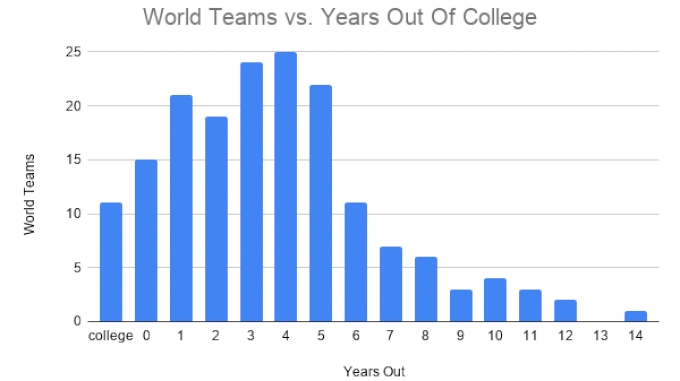
Now, of course, this data is going to skew younger at the front end because that’s simply how professional sports work. Most NFL players are toward the end of their career around age 30, while most are beginning their careers in their early 20s. However, I want to point out the largest chunk of world and Olympic teamers comes in the range of year three to year five.
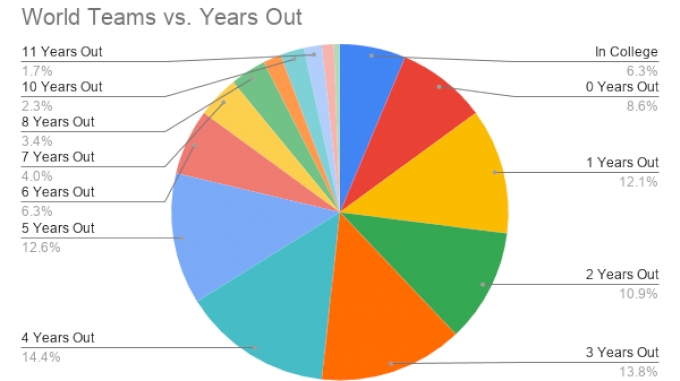
My data set looked at three different time periods of weight classes: 1997-2001 when there were eight weights, 2002-13 when there were seven weights, and 2014-2019 when the number varies between six and 10 but with the constants of 57kg, 65kg, 74kg, 86kg, 97kg, and 125kg. All told, 40.8% of the guys we sent to the world championships or Olympic Games were in their third, fourth, or fifth year out of college. That’s 71 spots out of a possible 174, and it should in no way surprise anyone.
The average age of a medalist for all male sports in the Summer Olympics was 26.2 years old for the time period between 1992 and 2012. Most studies you find will place peak Olympic performance somewhere between 25 and 27 years of age, depending on the time period being reviewed. Why should we think wrestling would be any different?
The data just backs up what makes logical sense. An athlete who has spent 4-6 years training folkstyle, battling injuries, going to class, pursuing outside interests, and developing romantic relationships is not exactly an ideal candidate to excel on the world stage. Now obviously some do, but what is clear is that the overwhelming majority need a year or two to focus solely on freestyle, get past their studies and settled in their life before they can achieve their athletic potential in what is, remember, a different style than folk.
Yes, there are crossovers. But every moment drilling crab rides or bottom work is only going to be so effective once you have to switch to gut wrenches and head pinches, not to mention the drastic impact of the stepout rule. So there’s the learning curve and the ability to focus on freestyle, plus the seemingly incontrovertible fact that most (but not all) human males peak athletically in their mid-20s.
Now what about those guys whose best years do come right out of college? Well, I have pretty strong feelings and opinions about why that is, although these are anecdotal and difficult to prove casually, but you can understand the correlative aspects.
Let’s take Tony Ramos. The North Carolina assistant made two world teams, one in year zero and the other his first full year out of college. He made the finals the next two years and was third on the ladder in 2018. So what happened? Did Ramos fall off?
I believe it was a combination of things. One, Ramos did a ton of freestyle growing up, competing year after year in Fargo and Akron, plus doing FILA Juniors and University Nationals several times in college. So he had spent hours and hours practicing freestyle by the time he graduated college. Second, the quality of competition at 57kg was simply not as good in 2014 and 2015 as it was over the course of the next three years.
That second point rears its head again with Ed Ruth, who made the world team at 86kg in 2014, or year zero as it was his final year of eligibility for Penn State. Did Ruth get worse a year later when he finished second to Jake Herbert? Or did a stronger opponent come back into the fray? Remember, Herbert was a 2009 world silver medalist and 2012 Olympian.

While I won't pinpoint a ton of exact guys for my next two theories, I so strongly believe them that it will take a very persuasive man to convince me otherwise. I think most wrestlers' bodies simply break down. I believe Dustin Schlatter falls into this category. Could he have continued making world teams with the group coming up behind him? Maybe, maybe not. But his body was so beat up it became that much more difficult.
Another pervasive thing I see is structure. One reason some guys do really well right away is the structure of a college room and grinding with 30 guys month after month after month. It puts them in excellent physical form and a strong mental state, and once they graduate and their senior-level career is more on their own and less team-based, they lose that edge. Lastly, I believe many of our guys who do best right away or make a team early and then don’t later on is that they get scouted. For some Americans, you only get one shot to surprise everyone, and then they figure you out.
OK, so that’s my thoughts on why there are some examples of guys having their best senior-level years in college or year zero. But let’s get back to the data, and examine a few test cases.
James Green was a four-time All-American for Nebraska, finished seventh twice and third each of his final two years in Lincoln. Then he came right out, made the world team in year zero, and won a bronze medal. He’s held the 70kg spot since then.
Greezy won a medal right away. But he won a superior medal in 2017, in year two, after being able to focus solely on freestyle. That was probably Green’s best season, and then the weigh-in rules changed. His production saw a bit of a dip in 2018 and 2019, but he continued to make the world team.

So what to make of that folkstyle diehards? Was Green hardened by folkstyle when he won that medal in 2015? Or did the years outside of practicing top/bottom allow him to hold the spot and continue to be world-class? Or is it simply that, for the past five years, James Green has unquestionably been the best man at 70kg in America regardless of how far out of college he is?
Guys like Green are perfect for this, because they don’t skew the data in either direction. But what about Jordan Burroughs? Yes, he won a world title in year zero, all the way back in 2011. But then he did so again in 2012, and 2013, and after tearing his ACL in 2014 won his fourth gold medal in 2015. So again I ask you college wrestling fans, if you give all the credit to folkstyle in 2011, then what do you make of his success in 2015?
Let’s not forget his most recent world title, the odds-defying 2017 crown. The world team data suggests a dropoff in performance in the sixth year out of college, which again makes logical sense. If you look at the five guys who made team in year six during the 2014-19 time period, it ranged from the year they turned 28 to the year they turned 30. Seems to fall in line with academic performance in other sports: most guys are going to fall off around that age.
Anyway, getting back to 2017. There is simply no way you can give folkstyle or college wrestling anywhere close to the amount of credit that you can give to full-time freestyle focus. Burroughs spent five years as a Husker, four on varsity plus one medical redshirt. After defeating Khetik Tsabolov in Paris, he had spent more time than that being a senior-level athlete.
There are certainly freaks, or aliens, or unicorns, or whatever you want to call the guys on the far ends of the spectrum. Since 1997 we’ve seen 11 guys make the world or Olympic team and still have college eligibility remaining. Similarly, there have been 10 guys to make a team after being out of school for a decade or more. That maps.
Now, to close this out, I will concede that our senior-level teams are getting younger. From 1997-2001, the average world teamer had been out of college for 4.05 years, and only one out of 40 made the team with college eligibility. That was Stephen Abas, who would hold the spot for four years and have his best performance in year two, when he won an Olympic silver medal in 2004. Again, it was not necessarily college that helped him in 2001, it was simply that he was the best guy at the weight. There were also five guys who made the team with 10+ years of experience.
During the time period of 2002-13, out of 84 spots earned the average time out was exactly four years. However, there was a higher percentage of guys who made the team while still in college, and a lower percentage that made teams with a decade or more time out of college. But again, look at who those guys were that made teams in college. Jake Herbert was still making teams in 2015, and Jake Varner was still the guy in 2014; both were on the 2009 world team.
Then there’s Henry Cejudo, who I defined as in college since he graduated high school in 2006 but made the world team in 2007 and then won the gold medal in Beijing a year later. So even though he counts for the college-age metric he literally did not wrestle a single collegiate match, and does not at all count for the NCAA hardos.
Which brings us to the medals (we'll get to 2014-19 in a second). In our dataset, three Americans won five medals while still in college. Pardon me though for thinking Kyle Snyder's three world and Olympic golds were not due to him drilling folkstyle, and that's easy enough to tell when you saw how he wrestled his NCAA matches. not to mention the fact that he often wrestled shortened seasons in order to have a more robust senior-level schedule.
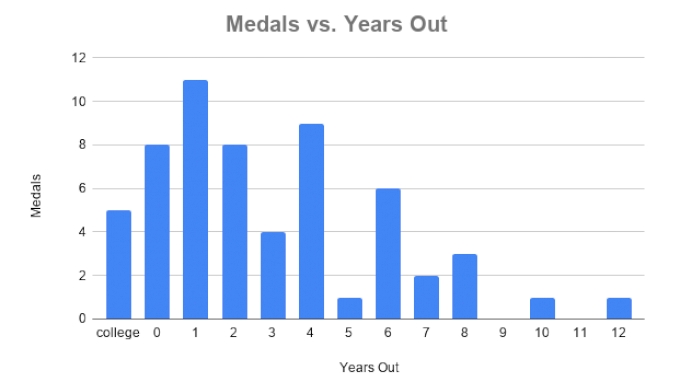
Eight wrestlers won medals in the year of their graduation: Cary Kolat, Stephen Neal, Herbert, Burroughs, Green, Gilman, Cox, and Snyder. Neal never made another team, transitioning to football after losing in the Olympic Trials to six-time world/Olympic teamer and 2003 silver medalist Kerry McCoy. Herbert never won another medal but made two more teams. Gilman made the team the next year and his career is still ongoing.
The highest number of medals won comes in the first full year out (11), however, the second-highest comes in year four (9). Year zero ties with year two for third-most (8) and year six closes out the top five (6). Making it all the more confusing is that years three and five, when the most guys make a team, have a relatively low number of medals, combining for just five podiums out of 46 opportunities.
Coming back to our most recent period of 2014-19, and the average time out is just 2.88 years.s During this time we’ve seen the unicorn that is Kyle Snyder and the alien J’den Cox, as well as Zain Retherford and Daton Fix make teams while still having NCAA eligibility. We’ve seen no one make it after 10+ years (the oldest were Burroughs in 2019 and Tervel Dlagnev in Rio at eight years each).
You and I both know how that happened, though. This group came up in an age where technique was readily available to them, on Flo, on YouTube, and damn near every important match since 2010 has been streamed online. Beyond that, Cadet world was reinstated in 2011, and a renewed emphasis has been placed on Junior worlds that fell off in the late 90s and early 2000s. People are getting smarter about weight cutting, and strength training for high schoolers is becoming ever more sophisticated. These kids have had access to the best of the best since middle school, and kids are coming into college more ready than ever, which has carried over into freestyle as well.
Don’t forget, though, history tells us that J’den, Kyle, Daton, and Zain will continue to make at least a few more world teams each. Oh, and let me also point out JB again, plus Dake and Taylor who did not make world teams until they were at least four years out of school. Dan Dennis and Tyler Graff also made their first team in year six. So even in this age of youth, the old guys are still hanging on, thanks in large part to the money available to them from our Regional Training Centers. Plus Cox's medals improved from bronze in college and year zero to gold the next two years.
All in all, I’ll leave you with this. The median time out from 1997-2001 was three years, and that held true from 2014-19. During the longer 2002-13, it was four years but just at that cutoff. The highest year for each time period, in chronological order: one and three years for 97-01 (six guys), five years for 02-13 (14 guys), and four years for 14-19 (eight guys).
It’s very simple, folks. If you’re picking a world teamer out a hat, odds are, you’re looking at a guy who is 3-5 years out of college. If you're searching for a medalist, the first and fourth years out are your best bet.