In this week’s “By The Numbers” we look at a comparison of the Golden Grand Prix and US National finals. Freestyle focuses on exposure, and it might surpris
Dec 26, 2015 by Brock Hite
In this week’s “By The Numbers” we look at a comparison of the Golden Grand Prix and US National finals. Freestyle focuses on exposure, and it might surprise you to see the statistics of who is scoring exposure from what position.
There were significantly more takedowns in the finals of US Nationals than there were in the Golden Grand Prix finals. This stat works directly with the two and four-point exposures. Americans are scoring more takedowns, while international competitors are scoring exposure from the neutral position more often.
Even from small sample sizes there seems to be a trend. I originally wrote about this when analyzing the Bill Farrell finals . Americans seem to be programed from folkstyle to gain control instead of looking for exposure. In the past when takedowns were one point and exposure was two, this was a very poor scoring strategy. With the change in scoring it isn’t quite as detrimental.
Keep in mind scoring in this situation is just as much a result of the defensive wrestler’s reaction as it is the attacking wrestler’s offense. Is it the offensive thinking of control, or the defensive thinking of Americans to not give up exposure? Someone could present a doctoral dissertation on the topic and probably not do it justice.
My preliminary guess is it is a mixture of both the offensive thinking and the defensive reaction. Scrambling and ankle passing is prevalent in folkstyle. Almost everyone you hear talk about it says it is hurting our freestyle. Therefore guys abandon a lot of defense they have used for years in the folkstyle setting. With takedowns and exposure both being worth two points wouldn’t it be worth fighting the takedown in an unconventional manner where you give up the exposure instead of the takedown rather than bailing out? It is certainly worth digging into at a deeper level with larger sample sizes.
Wrestlers have learned to stay in bounds or become grounded before they get to the boundary line in order to not give up a step out point. In one of the most bizarre matches at Golden Grand Prix 2014 world champion Khetik Tsabolov fought off giving up two step outs. It sounds like a good thing, right? Wrong, in those two exchanges he fought feverously to stay in bounds. Hasanov scored a two-point takedown and a four-point exposure as Tsabolov refused to go out of bounds.
This was a tragic display of tactics. The match was won by Hasanov 12-8. Had Tsabolov just conceded the step out points the match would have been very different. Hasanov may very well have still won, but the scoring would have look very different. You expect to see these tactics catch up with an age group wrestler in Fargo, not a world champion from Russia.
This was interesting data to me. At the Golden Grand Prix the winning wrestler was your more aggressive wrestler in all bouts except for one. Can you guess who the losing wrestler was that out attacked their opponent? If you said, “Logan Stieber,” you are correct.
Americans seem to up their attack rate and try to score through volume when they trail in the second period. This doesn’t seem to be the international thinking when they trail in a bout. It also works with the leading wrestler’s mentality. If they keep their foot on the gas they will continue to match or exceed the attack rate of the opponent who is trailing. I want to dig deeper and analyze the attacks beyond the surface level.
Surprised? I know I was. The idea that Americans are inferior par terre wrestlers has been drilled into our heads. This data could support that by saying the defensive par terre wrestler was not defending well, and that is why the US Nationals had four times the number of turns in one less bout. Until the Americans are competing in a field of international wrestlers you can’t determine much from the data. Are we good on top, or are we bad on bottom? Same thing for the international field at GGP. Are they miserable turning guys from par terre, or is the par terre defense that impecable?
The real surprise for me was that the winning wrestlers at GGP didn’t have a single turn from par terre. I watched the whole tournament, but only broke down the championship finals. I think this stat speaks more for the defensive par terre work of the losing wrestlers. Many of the champions had great turns throughout the day, they just didn’t execute in the championship finals.
Scoring and action is up greatly under the new rules. The officials don’t have to involve themselves much. However, I would like to see a rule change here. I like the progression of the passivity calls in Greco Roman better than freestyle. It incorporates all three positions of wrestling when you force the passive wrestler into par terre. It is easier to defend in freestyle so it might not promote the same amount of action. A possible solution could be the one point being awarded for the third passivity call and the passive wrestler is then put into forced par terre. I would rather see that than a second shot clock.
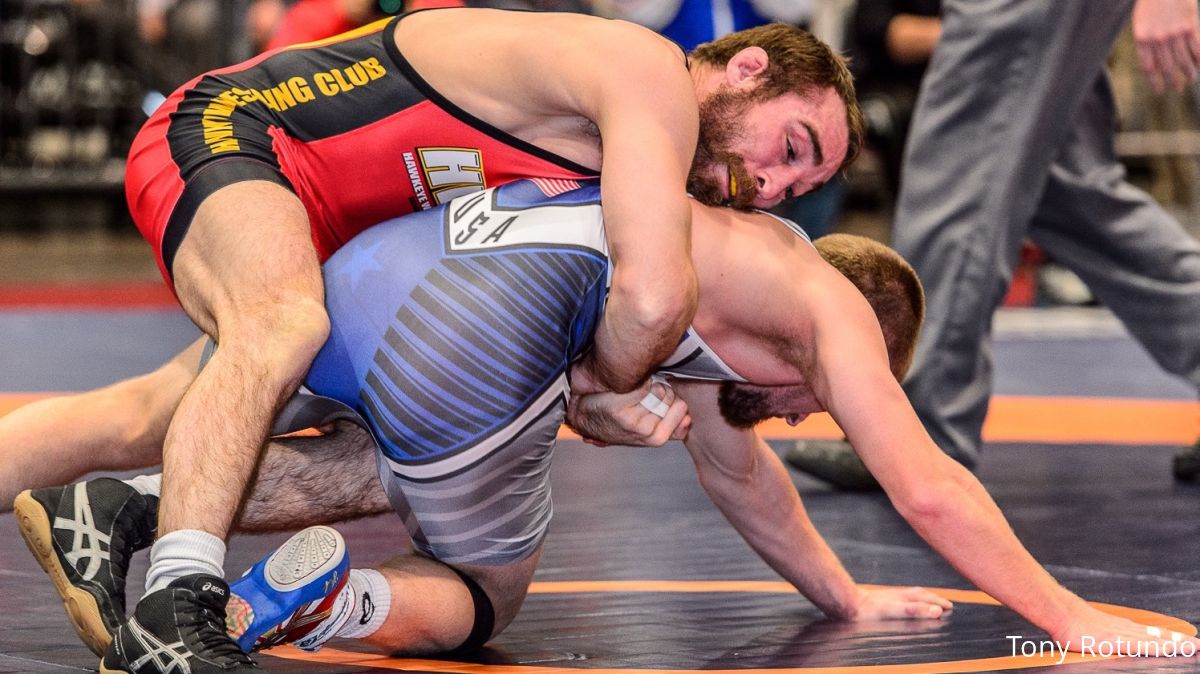
 Photo: Tony Rotundo
 Photo: Tony Rotundo