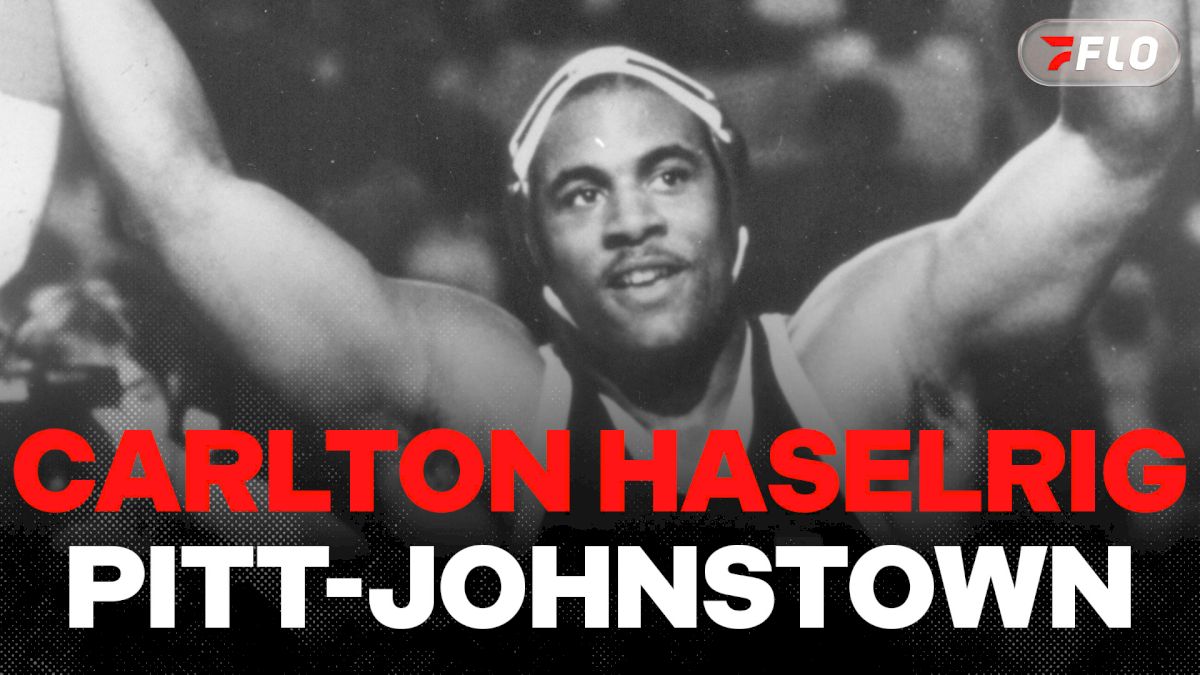
Mention Carter Starocci’s five NCAA titles, or any of the other six four-time D1 champions, and a wrestling fan will likely chime in with, “Yeah, but Carlton Haselrig won six.”
The above statement is true. Haselrig won three Division II NCAA titles and three Division I NCAA titles for Pittsburgh-Johnstown from 1987 through 1989.
His inclusion on the NCAA’s 75th anniversary team in 2005 and his induction into the National Wrestling Hall of Fame in 2016 are warranted, and he is the conversation as a top-three college heavyweight.
And, yes, winning six NCAA titles is impressive. This was during a time when the Division II NCAA champion qualified for the NCAA Division I tournament two weeks later.
Haselrig’s greatness isn’t about winning six NCAA titles; it’s about winning three D1 championships and his unbeaten streak. Sure, calling someone a six-time NCAA champion sounds cool — and it is cool — but it’s semantics.
D1 Conference Titles vs D2 NCAA Titles
Look at it this way: the D2 NCAA Championships were qualifiers for the D1 NCAAs.
Be honest: Is winning the Big Ten Championships or the Big 12 Championships tougher than the NCAA D2 Championships? There are exceptions, but within the past 25 years, save when Tervel Dlagnev of Nebraska-Kearney and Les Sigman of Nebraska-Omaha were vying for D2 heavyweight supremacy, the answer is, for the most part, yes.
Cael Sanderson won four Big 12 titles and four NCAA titles. Winning his conference tournament is what qualified him for the NCAAs. Had he wrestled at the D2 NCAA tournament, Sanderson would be an eight-time NCAA champion (under the old format).
It’s also worth mentioning that Clarion’s Don Rohn won the 1973 NCAA D1 Championships after finishing third in the D2 tournament (the top three qualified), and Clarion had three champions (Rohn, Wade Schalles, and Bill Simpson).
Schalles and Portland State’s Rick Sanders each won two D2 and D1 championships for four total, but most don't call them four-time NCAA champions.
Sanders lost the 1968 Division I finals to Oklahoma State’s Dwayne Keller, became the country’s first (or second) World champion in 1969, and won two Olympic silver medals (1968 & 1972). Those are the focal points of his career.
"Carlton Haselrig is the best wrestler I ever faced. He took to wrestling quickly and established himself as one of the greatest, if not the greatest, heavyweight in NCAA history." -- Kurt Angle, 1996 Olympic gold medalist
Schalles was robbed of his senior postseason after moving up two weights during the year and pinning the eventual 177-pound NCAA champion during an open tournament. He also pinned his 100th college victim on a tiny X created with medical tape. His NCAA titles seem secondary to innovation.
Gray Simons won three NCAA (1960-62) and four NAIA titles (1959-62) for Lock Haven, making him a seven-time national college champion (and six-time Outstanding Wrestler), but that doesn’t have the same ring as a six-time NCAA champion.
Even the National Wrestling Hall of Fame’s biography about Haselrig is wrong. It states that he never lost or tied a match in Division II, which is impossible since he finished third at the 1986 NCAA Division II Championships, losing to Edinboro’s Dean Hall 8-6 in the semifinals.
Breaking Down Wrestling Haselrig's Career
Hall was a three-time D1 All-American (6th, 2nd, 7th from 1986-88) and lost to Haselrig in the 1987 D1 finals. Edinboro moved to Division I after the 1986 season, preventing these titans from facing off at multiple D2 national tournaments.
Haselrig is an all-time great because he had a 122-match unbeaten streak (yes, there were ties) and a 143-2-1 career college record. He only wrestled one high school postseason (10-0) on a one-man team of Carlton Haselrig (he won the 1984 Pennsylvania state championships).
For context, Haselrig defeated Jon Llewellyn of Illinois 9-4 in the 1989 NCAA tournament semifinals. Llewellyn eventually finished third twice before winning the 1991 NCAA Championships.
Haselrig’s last college match was a 1-0 victory over Northern Iowa’s Joel Greenlee in the 1989 NCAA finals, a wrestler he tied in the 1988 All-Star Classic.
“Haselrig accomplished amazing things in his athletic career,” Greenlee said. “He was big, strong, quick — he had every attribute you need to be a great athlete.”
Transitioning To Football
Haselrig attended Lock Haven to play football but transferred to Pitt-Johnstown during his freshman year — a school without a football team. He chose wrestling, became an all-time great, then spent five NFL seasons as an offensive guard, earning a 1992 Pro Bowl selection.
Reminder: Haselrig didn’t play a down of college football.
“Most people spend a lifetime trying to make it to the NFL,” Greenlee said. “He not only made it but was a pro bowler.”
Wrestling missed out on potential domestic showdowns with Bruce Baumgartner, a 13-time World/Olympic medalist and five-time World/Olympic champion who won 1992 Olympic gold and 1993 and 1995 World gold in his 30s, when Haselrig was in his prime.
Or, if he had stuck around for the 2000 Olympic cycle, matches against 2003 World silver medalist Kerry McCoy and 1999 World champion Stephen Neal.
So, how good was Haselrig? Take it from Clarion’s Kurt Angle — a two-time NCAA champion, three-time finalist, 1995 World champion, 1996 Olympic gold medalist, and fellow member of the 75th NCAA anniversary team.
“Carlton Haselrig is the most talented athlete I’ve ever wrestled,” Angle said. “He was 280 pounds and moved like a cat. He was very light on his feet. He took to wrestling quickly and established himself as one of the greatest, if not the greatest, heavyweight in NCAA history.
“Carlton was my very first match my freshman year in college. Although I put up a good fight as a freshman and ultimately surprised myself (the score was 4-1), Carlton made the win look easy. He was so versatile, powerful, and quick. He was a coach’s dream.
“If Carlton had pursued wrestling instead of football after college, he would have been an Olympic gold medalist. He’s the best wrestler I ever faced. The second time I wrestled him, I narrowed the score to 5-3, but he easily won the match. He always made it look easy because he was so fluid.
“Carlton is a legend and had a huge impact on my career. After my freshman year, he allowed me to come to his college and train with him. We had some incredible training sessions. He made me a much better wrestler because of it.”
Praise like that is bigger than winning six NCAA titles.
Carlton Haselrig's NCAA Tournaments
1986 NCAA D2 Wrestling Championships
R16: WON over John Kehrli (Portland State), 8-3
QF: WON over Randy Seiler (Lake Superior State), Fall 6:53
SF: LOST to Dean Hall (Edinboro), 8-6
CSF: WON over Craig Brooks (Oakland), 11-4
3rd: WON over Al Holeman (South Dakota State), 2-1
1987 NCAA D2 Wrestling Championships
QF: WON over Larry Eide (Central Missouri State), 10-2
SF: WON over Mike Monroe (Cal State-Bakersfield), 4-0
F: WON over Mike Hatch (Liberty), Fall 3:50
1987 NCAA 1 Wrestling Championships
R32: WON over Todd Myers (Millersville), 12-5
R16: WON over Andy Cope (Iowa State), 5-4
QF: WON over Tom Reese (Maryland), Fall 6:03
SF: WON over Rod Severn (Arizona State), 6-5
F: WON over Dean Hall (Edinboro), 4-2
1988 NCAA D2 Wrestling Championships
R16: WON over Jeff Foster (Chicago State), Fall 5:19
QF: WON over Alex Koehler (San Francisco State), Fall 6:09
SF: WON over Tim Lajcik (Cal-Davis), 14-6
F: WON over Randy Sieler (Lake Superior State), Fall 6:44
1988 NCAA D1 Wrestling Championships
R32: WON over Steve Adams (Central Michigan), Fall 6:13
R16: WON over Randy Seiler, Lake Superior, Fall 4:32
QF: WON over Mark Tatum (Oklahoma), 9-1
SF: WON over Rod Severn (Arizona State), 6-3
F: WON over Dave Orndorff (Oregon State), 12-2
1989 NCAA D2 Wrestling Championships
R16: WON over Jason Math (Minnesota State-Mankota), DQ 6:26
QF: WON over Jim Beson (Ferris State), 14-6
SF: WON over Eric Drenth (South Dakota), Fall :56
F: Clark Schnepel (Nebraska-Omaha), 20-7
1989 NCAA D1 Wrestling Championships
R32: WON over Mark Snuffin (American), Fall 4:22
R16: WON over Rob Cole (Syracuse), Fall 1:45
QF: WON over Andy Haman (Iowa), 4-1
SF: WON over Jon Llewellyn (Illinois), 9-4
F: WON over Joel Greenlee (Northern Iowa), 1-0