by Milana Borrelli
Audrey Jimenez’s story lives in the way she talks about home, faith, and the strange feeling of realizing, only when someone reads her accomplishments out loud, that she has already made history more than once.
When her accolades are stacked, four Arizona state titles at Sunnyside, including a groundbreaking boys championship at 106 pounds, age‑group world medals, and now an undefeated run to an NCAA women’s national title at 110 pounds for Lehigh – it sounds like the résumé of someone deep into a career, not a college sophomore.
Jimenez laughs a little when she hears it recited.
“When you put it into a list like that, it seems like a lot,” she says. “I never really thought of it like that. As time flies, I just continue moving forward.”
Growing Up In A Dynasty
To understand Jimenez, you have to understand Sunnyside. The Tucson powerhouse has become synonymous with wrestling excellence, producing NCAA champions like Roman Bravo-Young, Sergio Vega, and now Jimenez herself. But it’s also a place you can’t fully grasp from the outside; I had the rare chance to be there, in the room and in the stands, and only then did I understand how deeply that culture gets into you.
“The coaches at Sunnyside are truly amazing,” she says. “They know the system and know what it takes to become a champion. Even after practices, Coach Leon’s mindset talks helped me a lot to get into the right headspace. They are so supportive and get me everything I need.” In a room where winning is expected, the expectation is cushioned by a culture that insists wrestlers are more than their last result.
Representing Sunnyside never felt casual.
“It means so much to me,” she says. “I love this community, and I have such an amazing support system. Everyone has been so amazing, and I am so grateful I get to represent such an awesome group.”
That sense of we, not me, is woven through everything she says. Asked when she first felt she was wrestling not only for herself, but also for her family and community, she doesn’t point to a singular match or medal. Instead, she points to the environment itself.
“Considering my upbringing at Sunnyside, I fortunately have had those values instilled in me,” she explains. “Coming into a great program that is known for great wrestling and seeing individuals accomplish success in the program allowed me to buy into the support system, culture, and community. We all do it together, we are one.”
Carrying Pressure, Then Learning To Set It Down
From the outside, it’s easy to imagine the pressure of being “the next” great Sunnyside wrestler, especially for someone who shattered barriers by winning a boys' state title in Arizona’s toughest division. For Jimenez, that pressure was very real—but it was mostly coming from the mirror.
“I used to feel lots of pressure,” she admits, “but as time went on, I realized I was putting that pressure on myself because I wanted to do well and I am expected to win.”
The turning point came when she understood that the people who mattered most didn’t love her because of her records.
“My family and friends are going to think of me the same whether I win or lose,” she says.
With that realization, her relationship with wrestling began to change.
“Now I take that pressure off and just enjoy the process because wrestling is very unpredictable and doesn’t always go in your favor.”
That unpredictability became most obvious when her body forced her to stop.
When Wrestling Stops
“Injuries for sure,” she says without hesitation when asked about the hardest part of her rise. A major knee surgery left her on the sidelines for an extended stretch, unable to do the very thing that had shaped her identity.
“A couple of years ago, when I had knee surgery, I had a long period of recovery, and I couldn’t wrestle. Before that, my whole identity was centered around wrestling, and I had to learn that there is more to life than that.”
In a sport that glorifies toughness and “push through it” mentality, choosing rest can feel like weakness. Jimenez had to rewire that thinking.
“It is also hard as a wrestler to listen to your body and take time to heal when it’s giving you a direct signal,” she says. “It’s easy to say I am tough, I can push through, but I learned that listening to your body and being healthy is so important in the long run.”
The time away from the mat forced her to grow into life outside of wrestling, not in opposition to her ambitions, but in support of them.
Faith, Outdoors, and Finding Herself
When she needs to reconnect with who she is outside of wrestling, Jimenez turns to two anchors that have nothing to do with scoreboards.
“I like to reconnect in church, that’s a big part of who I am and helps me stay centered,” she says.
Faith gives her a framework for both success and setback, a place where her value isn’t measured in wins.
She also gravitates toward the outdoors. After years of grinding in hot wrestling rooms, the simple act of being outside helps her reset.
“I also enjoy things outdoors as well,” she adds.
Whether it’s a walk, fresh air, or just distance from the mat, those moments allow her to remember that life is bigger than a season, a bracket, or a single match.
A New Home At Lehigh
When it came time for college, Jimenez didn’t just choose a school; she chose a place where she believed both wrestling and academics would stretch her. She committed to Lehigh University in Bethlehem, Pennsylvania, arriving as the women’s program was still transitioning from club status toward full Division I recognition.
“I decided to go there because they had a lot to offer for me and I could see myself continuing to grow and develop there,” she says. “I also wanted to go to a school and get a good education, that is something that was very important to me.”
That balance, chasing titles while prioritizing the classroom, echoes the values she absorbed at Sunnyside and at home.
Her first year at Lehigh, though, was anything but easy.
“It definitely was challenging,” she says of the transition away from a tight-knit community into full independence. “I struggled a lot my first year here fitting in, and I was finding every reason I could to come home.”
For someone used to being surrounded by familiar faces and a long-established culture, the shift to a new team, new teammates, and a new region of the country was jarring.
Over time, that changed.
“Now I see Lehigh as a second home, and I am loving it here now,” she says. “It just took time.”
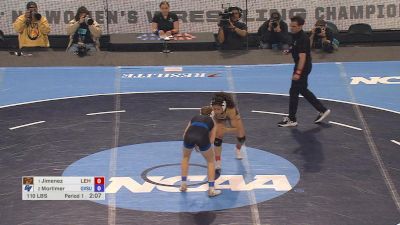
That “second home” has become a place of history, too: in Lehigh’s inaugural women’s varsity season, Jimenez went undefeated and captured the 110‑pound national title at the first NCAA women’s wrestling championships, earning Outstanding Wrestler and Most Dominant Wrestler honors.
“This year was truly amazing with Lehigh,” she says. “So far, I really like it here. Especially since I came in as Lehigh was still a club, I am glad it is officially a D1 school, and I’m so grateful I got to compete at the first-ever NCAA women's national tournament. It’s so cool to see how much the sport has grown and will continue to grow, and it was such a great experience, and I had a lot of fun competing there. It felt very special.”
Learning To Speak Up
Being on her own in a completely new environment didn’t just stretch her as an athlete; it pushed her to grow as a person. Asked about the biggest lesson she’s learned so far in college, she doesn’t talk about technique or conditioning. She talks about her voice.
“I would say it’s communication,” she says. “I am in a completely different environment surrounded by different people, and I’ve learned how to express myself more clearly and communicate my feelings to teammates and friends.”
The same intentional mindset talks she once listened to at Sunnyside has, in a way, become internal. Now she is the one articulating needs, boundaries, and emotions to the people around her.
Looking Toward 2028
Even as she recovers from another surgery, Jimenez’s goals remain as ambitious as ever.
“I plan to take this summer and heal from my recent surgery, and I will be back competing in the college season in the fall, and preparing for the 2028 Olympics coming up as well,” she says.
The path from Tucson to the Olympic stage is steep, but she has already proven she can climb unfamiliar terrain—across state lines, divisions, and expectations.
“As long as I am healthy and still loving this sport, I’ll be competing,” she adds.
It’s a simple sentence, but it holds everything she has learned so far: that health matters, that love for the sport matters, and that neither should be sacrificed entirely for the sake of one more match.
In the end, Audrey Jimenez is still the kid from Sunnyside who fell in love with wrestling in a co‑ed room where girls were rare, and dreams were big. She is also the national champion who now walks onto the mat representing not just her high school, but Lehigh, Tucson, and a rapidly growing generation of women who finally have an NCAA bracket to chase. She moves forward quickly, sometimes so fast she forgets to look back at the list of what she has already done.
When you read it to her, she pauses, smiles, and then does what she’s always done: she keeps going.
Audrey Jimenez: By The Numbers
● Four-time Arizona Division I state champion in high school, including one boys’ state title, becoming the first Arizona girl to win a boys’ state wrestling title. ● 2019 U15 Pan American gold medalist.
● 2021 U17 World bronze medalist.
● 2022 U20 World silver medalist.
● 2023 U20 World silver medalist.
● 2023 U23 World silver medalist.
● 2024 Pan American bronze medalist.
● 2024 U.S. Olympic Team Trials runner-up, earning a place on the U.S. Senior National Team.
● 2025 Pan American gold medalist.
● 2025 U20 World silver medalist.
● 2025 U23 World silver medalist.
● 2026 NCAA Women’s National Champion at 110 pounds.
● 2026 NCAA Outstanding Wrestler Award winner.
● 2026 NCAA Most Dominant Wrestler Award winner.
● 2026 NCAA Women’s Wrestler of the Year.
● 2026 NCAA Region 2 Wrestler of the Year.
● 2026 Anthony-Maroulis Trophy winner.