Whether you like it or not, NCAA Division III women’s wrestling programs will host their own championship during the 2027-28 season.
The reason? Competitive balance.
It should shock no one that this was the inevitable direction for women’s college wrestling. Division III schools do not offer athletic scholarships, so a separate end-of-year tournament makes sense.
D3 Hobart College in Geneva, New York, doesn’t face Power Four Alabama for the NCAA men’s football championship. Why would D3 Eureka College in Eureka, Illinois, face Power Four Iowa for the NCAA women’s wrestling title?
“Any time an athletic director adds a sport, the first question they will ask is if we can be reasonably competitive to justify it,” NWCA executive director Mike Moyer said. “No athletic director wants to add a sport where they can’t provide a quality experience. It doesn’t mean they have to win a national title. They just want to know if we can reasonably provide a good experience.”
This is what competitive sports do.
Double A teams play Double A teams in baseball.
G League teams play G League teams in basketball.
D3 schools face other D3 schools in wrestling.
“The split was a long time coming, and in the grand scheme of women’s wrestling, it allows us to continue to grow at a high rate,” Eastern coach Andrew Taylor said. “With Division III passing the vote to split off for our own championships, Division II and Division I can use the momentum to continue their growth as well.
"The split was a long time coming." - Eastern coach Andrew Taylor
“For our program at Eastern, it really only changes how we approach things for two weekends out of the year. We will still be recruiting athletes who want to chase World Teams, and we will still be creating a schedule that allows us to compete against some of the best programs in the country in all divisions.
“I am excited for what the leadership committee can do to create an incredible event, and our goal will be to chase a team trophy in that first year.”
What About North Central?
For the next two years, all three divisions will compete at the NCAA Women’s Wrestling Championships in March. This offers a unique historical opportunity for Division III programs to win championships and become All-Americans against their D1 and D2 counterparts.
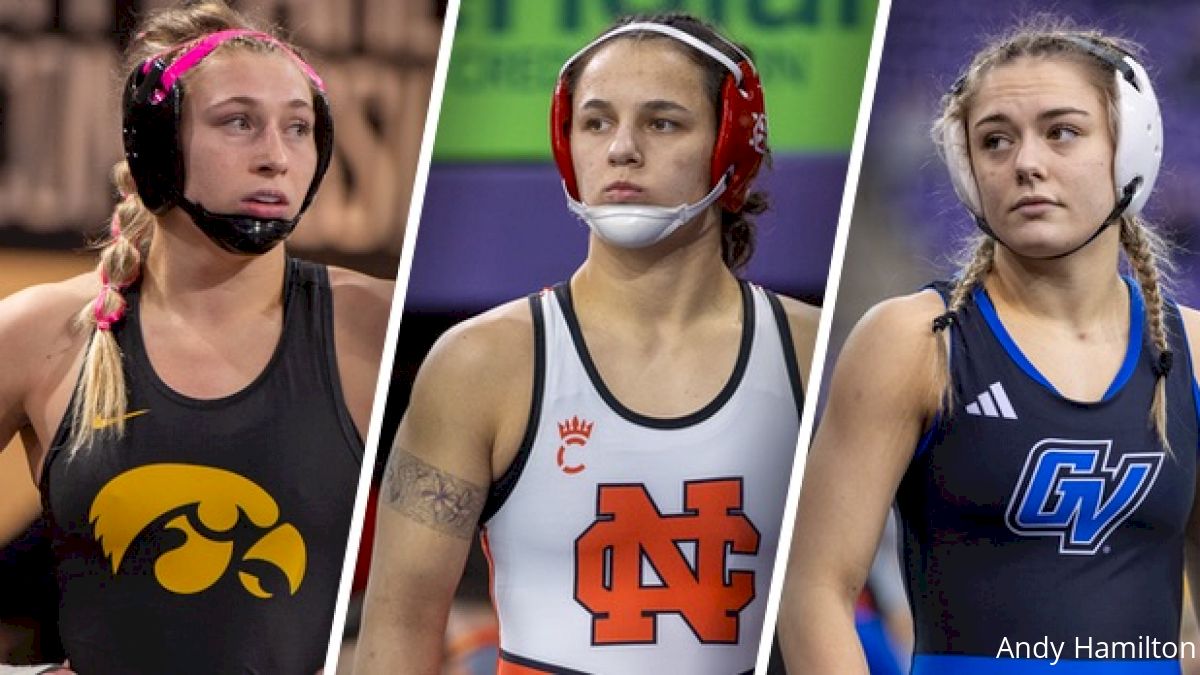
North Central — a Division III program in Naperville, Illinois — is the outlier. The Cardinals won the 2023 National Collegiate Women’s Wrestling Championships (without Iowa), then finished second to the Hawkeyes in 2024 and 2025.
The Joe Norton-led squad won the 2026 NWCA National Duals on January 9-10, handing Iowa its first dual loss in program history with a 23-21 semifinal win. North Central defeated McKendree in the finals, 21-18, for its first National Duals title after finishing second three straight years.
News of the D3 split was announced on January 16, leading some to speculate that North Central’s recent National Duals success against D1 and D2 teams played a factor.
This isn't true.
The driving force was the announcement that the NCAA Championships would feature 18-woman brackets at each of the 10 weights. Had it been 21 or 24 qualifiers per weight, a split may have been delayed.
NCAA women's programs by division
Fear The Bird
North Central’s four-season run is staggering. The Cardinals are 55-5 in duals, and have placed 145, 160, and 110.5 points ahead of the next closest Division III team at the national championships.
“I hate (the split),” Norton said. “Selfishly, I hate it.”
“If you asked our women if they want to go and have the experience they had last year, they would take it. We lost by 19.5 points, but we were winning going into day two. To have that experience and to go toe-to-toe with the Hawkeyes and fall short and lose, or win by 145 points? Our girls would choose losing. Our girls would take the experience they had over winning by 145 points (at the Division III NCAA Championships).
"Selfishly, I hate the split." - North Central coach Joe Norton
“I’m answering questions right now from recruits that don’t want to come here because we are going to be D3. Over time, we aren’t going to have that level of athlete, regardless of how good our coaching staff is. It’s not like we go D3 and we’re not as good of coaches. We’re the same coaching staff, but we’re not going to coach the same high-level athletes.”
Playing The Lotto
Norton won’t go down without a fight. He’s exploring a multidivisional classification that allows a Division III program to compete at the highest level. That’s why the Franklin & Marshall (D3) and Lock Haven (D2) men’s wrestling teams compete at the NCAA D1 Championships.
The multidivisional rule no longer exists, but Norton will petition. Moving from D3 to D1 is a 12-year process for an athletic program, so that’s off the table. He will use St. Thomas University to bolster his case. The NCAA granted the Tommies permission to move directly from D3 to D1 in 2021.
Could the North Central women’s wrestling team do the same?
Here’s where it gets tricky. Athletic directors want to win championships. Is it better to win a D3 team championship just like every other program at North Central is striving to do, or go toe-to-toe against Iowa, McKendree, and Grand Valley State to possibly finish second or fourth, or 10th?
Or, with the right tournament and the right recruits, maybe you win one at the highest level.
"You can’t win the lotto if you don’t buy a lotto ticket.” - Joe Norton
“We’re not asking for scholarships; we just want to compete in the national collegiate tournament, which is Division I and II for women’s wrestling. That’s still my optimistic hope. That’s what we want to do. Our athletic director has to agree, and our president has to agree. We can’t do anything if our president doesn’t agree to do it. And the NCAA would have to approve a petition.
“The odds are, in 2028, we are going to be Division III, but we are going to take this shot in the dark and see what happens. I’ve also told every girl, if you come here and we split off, and we don’t get to petition up, I’ll make the right calls to get you to the right place. I’m not going to handcuff you and make you stay here. If that’s your dream and you want to go do that, then we’ll do it. We’ll find the right program for you. I just told a recruit that yesterday.
“No one thought we were going to beat Iowa. We’re going to try. You can’t win the lotto if you don’t buy a lotto ticket.”
What About A Division II Split?
For now, D1 and D2 programs will host their own NCAA Championship when the D3 split happens.
Will D2 programs split like D3, leaving eight D1 programs on an island? Division II has the minimum number of programs to make the request, so they may move forward with it.
“I don’t know the answer to that, but I don’t know why they couldn’t,” Moyer said. “I’ve never been told they couldn’t, but I’ve never been told for certain if they can’t.
“No matter what, we need to add a lot more D1 and D2 programs, and that’s exactly what the NWCA is working on.”
Also, how many national qualifiers will each division have? Under the current format, there are 18. It seems likely that the number will decrease when the split happens in 2028.
Will it be 4 qualifiers? 8? 12? 16?
“No matter what, we need to add a lot more D1 and D2 programs, and that’s exactly what the NWCA is working on.” - NWCA executive director Mike Moyer
Colorado Mesa coach Travis Mercado likes a challenge, including battles with the Hawkeyes, but he also likes the idea of winning a championship against comparable programs. As it stands today, the Mavericks will continue to face D1 teams like Iowa, Lehigh, Presbyterian, Lindenwood, Sacred Heart, and Delaware State.
“Is it the right time (for D2 to split)? I don’t know,” Mercado said. “Competitive Travis Mercado and Colorado Mesa says, yes, we want to be able to compete amongst our peers and have an equitable opportunity to compete for a national championship against a similar school like Grand Valley State, McKendree, King, Quincy, and Fort Hays. Right now, you have one juggernaut in the University of Iowa.
“I think as Division I teams add and Division II teams add, then we can start to have this conversation of splitting off. I hope we’re at a point with women’s collegiate wrestling that we’re able to split off, we’ll have D1, D2, D3, NAIA, and junior college. I’m excited about that opportunity down the road. It might take two years. It might take five or 10.”
Either way, the landscape of women’s college wrestling is changing — fast.
What Other Division III Coaches Are Saying
Kasey Kruczek, Wilkes
“For me, I like seeing all the divisions wrestling together, but I also know how great it is to split off for those athletes with their training schedules. I think it comes down to preseason and postseason training schedules. Athletes can work out all year on their own, but I don’t get as much of the preseason with them as the other divisions. I get eight flex practices that I can coach with them, and our strength and conditioning coaches can work out with them, but I can’t be in there if it’s not on flex days.”
Tyler Keane, Western New England
"I love a D3 split. I think it allows Division III athletes to compete for a national title and All-American. Not that we don’t get to now, but this kind of evens the playing field. We have a bunch of athletes who are hungry for this split, and we can’t wait to compete. Right now, we’re focused and excited for the regional tournament and national tournament this year. When that D3 split happens, I think it gives a fair, competitive advantage for Division III athletes.
"I find it’s uneven when it comes to training. In terms of training and practices, and being able to be with your athletes during certain times of the year. Division I has more opportunities, and the big thing with D1 and D2 is athletic scholarships, which makes it difficult for D3, at least on my end, for recruiting."
Joe Jamison, Ursinus
"I think in the long run, for the growth of the sport and for the sustainability of Division III, I think it’s important. Selfishly, I hate it right now. As a women’s wrestling coach at a Division III school, it’s been a lot of fun to compete at the highest level possible. Right now, we have a ton of talent on our team, and we’re excited to continue to pursue our goals and try to get girls on the podium and win national titles at the highest level. At the same time, for the longevity of the sport, I know the split is important as it is going to level the playing field for the schools that don’t have the same resources as Division I and Division II schools.
"It’s twofold. There’s the financial piece where it comes down to budgets, resources available, and scholarships. As a Division III school, for the most part, our budgets are going to be smaller than those of Division I and Division II schools. It’s just the nature of how it works. They can offer athletic scholarships where we can’t.
"The other piece is the rules piece. Division I and Division II institutions can mandate athletic hours the minute they step on campus. They can mandate off-season hours where they are either in the room or in the weight room. For us, in Division III, we’re not allowed to do that. Coaches are not allowed to be around their athletes in an athletic setting at all until official practice starts. Division I and II schools start practicing eight hours a week, where we can’t do anything that’s mandated or even be with them until October.
"A lot of Division III schools have found a way around that with RTCs. If you have one, you can do certain things. You can’t mandate it, but it is available."