By Emili Lok
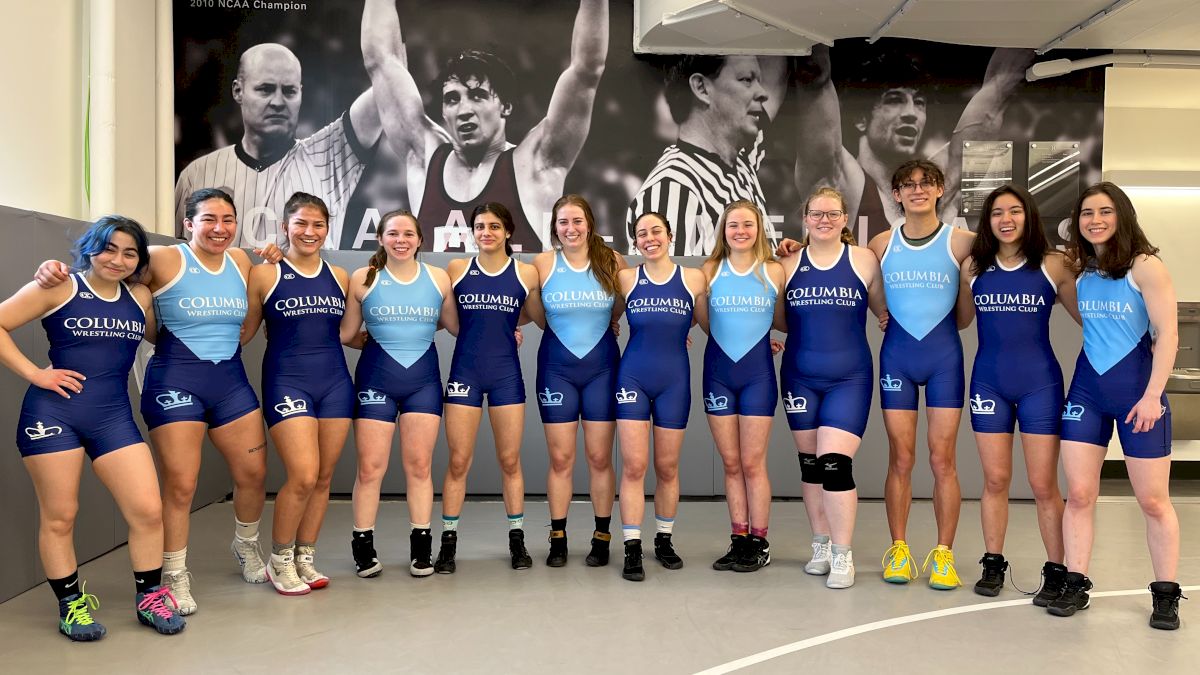
When Bri Csontos (CC’23) and Talia Fine (CC’23) arrived at Columbia University, there was no women’s wrestling team waiting for them. Instead, they faced a community of people who, for the most part, hadn’t even grappled with the concept that yes, girls can wrestle too. Yet, the two pioneering women made something out of nothing. Together, they began constructing what has now become a thriving program on the verge of varsity status.
Today, the Columbia Women’s Wrestling Club embodies grit, resilience, and community. However, in 2017, when Csontos first made her way onto College Walk, the team was merely an idea: a one-woman table outside of Low Library, a few supporters amongst a mountain of roadblocks, and a persevering dream that now comes true every day in the Andrew F. Barth Wrestling Room.
Wrestling Roots
Csontos discovered wrestling at her middle school in rural Virginia. Her case was unusual, as her middle school coaches’ daughter was on the team, meaning her first instance with the sport came from a team where girls' wrestling was emphasized. By high school, though, she was the only girl on her team. She maintained her connection with women wrestlers through opportunities at the national level, including Team Virginia at the Fargo Nationals and when wrestling for Team USA at the Pan American Championships. Fine, meanwhile, began her wrestling career in high school, inspired by seeing another girl wearing a wrestling sweatshirt and thinking she looked “cool.”
When the two women made their way to Columbia, they saw what was missing—a solid community for women wrestlers. “My older sister did club lacrosse,” Fine recalls. “She told me how having a team was important, and I wanted that same community.” Fine would go on to connect with Csontos in her hunt for colleges with wrestling programs. Csontos, at the time, was under a loose arrangement to wrestle at the university, coordinating with Carl Fronhofer, the coach of the men’s varsity wrestling team at the time, and Jacque Davis, head of BTS (Beat the Streets).
Creating a Club
From a logistical side, the roadblocks were numerous. Csontos attempted to create the club her first year of college, using the squash team’s club-to-varsity-pipeline as inspiration. She struggled as a freshman attempting to navigate an unfamiliar club chartering system. Beyond meeting the statutory requirements of a club, Fine notes that even upon their debut, the challenges persisted. From recruitment to the search for a high-quality coach with only a measly club budget, the team has overcome many setbacks.
The club always had ambitions to perform at a high level, but at first, there was a sense of awkwardness in trying to assert itself. Fine remembers the difficult transition period: “We had to lead with confidence—show that we belonged in the wrestling room and at competitions.” Csontos echoed the feeling of being an outsider, lamenting that she spent so much time feeling like she didn’t belong in the rooms she was in. With a positive tone, she stressed, “You always belong in that room, on that mat.”
Their perseverance paid off. They relied on the friends and allies they had from BTS, the PSAL, and members of the men’s team, alongside the guidance of coaches like Jacque Davis and, later, Emma Randall. The Columbia Women’s Wrestling Club grew from a rotating handful of students building off existing wrestling communities to a full, standalone roster of Columbia University women.
The Qualities of a Wrestler
Both founders agree that wrestling has shaped who they are beyond the sport. Csontos, who has worked in refugee resettlement and is currently a JD Candidate for George Washington University Law School, referenced resilience and adaptability as the greatest attributes she’s gained. She feels that “wrestling shows you a lot of qualities about yourself that you don't know are there until you have the opportunity to test them.”
For Fine, who now works in finance at BlackRock, wrestling taught her how to rebound after a setback. “Knowing that I can get hit and get back up comes from developing a toughness unique to wrestling,” she said. Sympathetic to the challenges and shortcomings that inevitably reveal themselves, Fine assures, “Mistakes happen and it can be difficult to navigate, but it’s rewarding knowing I can push forward. It’s all about reps and putting in time and effort into what you love.”
Favorite Moments
While the memories of winning titles and medals are glorious, both Csontos and Fine championed moments of camaraderie as their most prized memories with the team. For Csontos, this was the exhibition matches she wrestled after the men’s team’s dual with Stanford. Not only was it an opportunity to wrestle two student-athletes, one from ASU and the other from China, but Csontos said it was “seeing the schools embrace us as a sport” that truly highlighted the moment.
Fine noted a tradition within the Columbia Women’s Wrestling club: the intrasquad dual. “It was many girls’ first real matches. The vibe shifted from nervous to intense to excited,” she continues, “People got out of their comfort zones, putting everything on the line.” Fine proudly says, “The team got closer as a result of it and were able to use that opportunity as motivation to put themselves out there for more competition.”
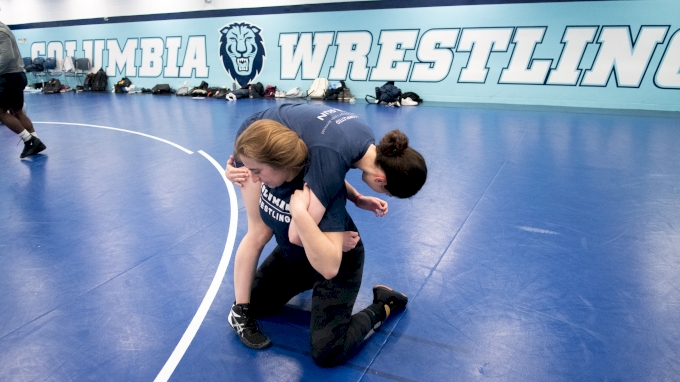
Columbia is working to become the first Ivy League school to add a D1 women's wrestling program
A Vision for Varsity
On January 17, 2025, women’s wrestling became an NCAA championship sport. Here and now, Columbia Women’s Wrestling is at the cusp of a historic leap to varsity status. Both Csontos and Fine see this as an opportunity to complete their legacy but also forever elevate what it means to be a girl who wrestles.
Csontos highlights the fact that Columbia could be the first Ivy League school in the nation to represent the sport in the NCAA. This accomplishment would make Columbia a special symbol, a place where women can get the education they want while also wrestling at the highest level.
Fine agrees: “Our vision has always been about women coming together to advance the sport and show the entire Ivy League and the NCAA that women’s wrestling is a force to be reckoned with. We’ve made it this far as a club; we can do even more as a varsity. “The country hasn’t seen the level of talent we have,” Csonto says, “When we get the chance to compete at the national championship, people will be shocked by how strong this team is.”
The Columbia Men’s Varsity Wrestling Team is the oldest in the nation. To carry on that tradition, Fine exclaims, “We deserve to be the first to get it done, too.”
Why Giving Back Matters
These interviews are a part of Columbia’s Roaring Forward Giving Day campaign, and both pioneers emphasize the importance of contributing to the community.
For Csontos, it’s as simple as “putting your money where the roar is.” In a world where we need stories of hope, Csontos cites the team as one of her biggest hopes. There is a power in seeing her team and her aspirations become real, and “The crux of the team and the movement is getting everyone the opportunities we always deserved.”
Fine encourages us to pay attention to how historically significant this present moment is for the team. “Columbia is a huge institution, and as individuals, you don’t always get the chance to say something is your legacy. But at this moment in the team’s history, it’s more important than ever to recognize how far we’ve come and work to solidify that.”
In Csontos and Fine’s years with the team, they never got to see the full fruit of a complete team practicing together. Csontos, with a tinge of melancholy, avows, “The girls deserve it—the girls have always deserved it.”
A Note to the Next Generation
When asked about what they’d say to the young girls who are following in their footsteps, both offered heartfelt encouragement.
Using wrestling as the basis of her advice, Csontos says, “Things that aren't perfect at first can be better, chipping away at a big goal. Like moving from one position to get better at this type of scramble, to this match, to this championship… go from learning individual moves to learning how to flow, and that's true for everything.”
Fine adds: “College is so much change. Lean into vulnerability. Stronger on the mat translates to stronger in the world. And remember—you have support on this team. There’s no classroom and no mat you don’t belong on.”