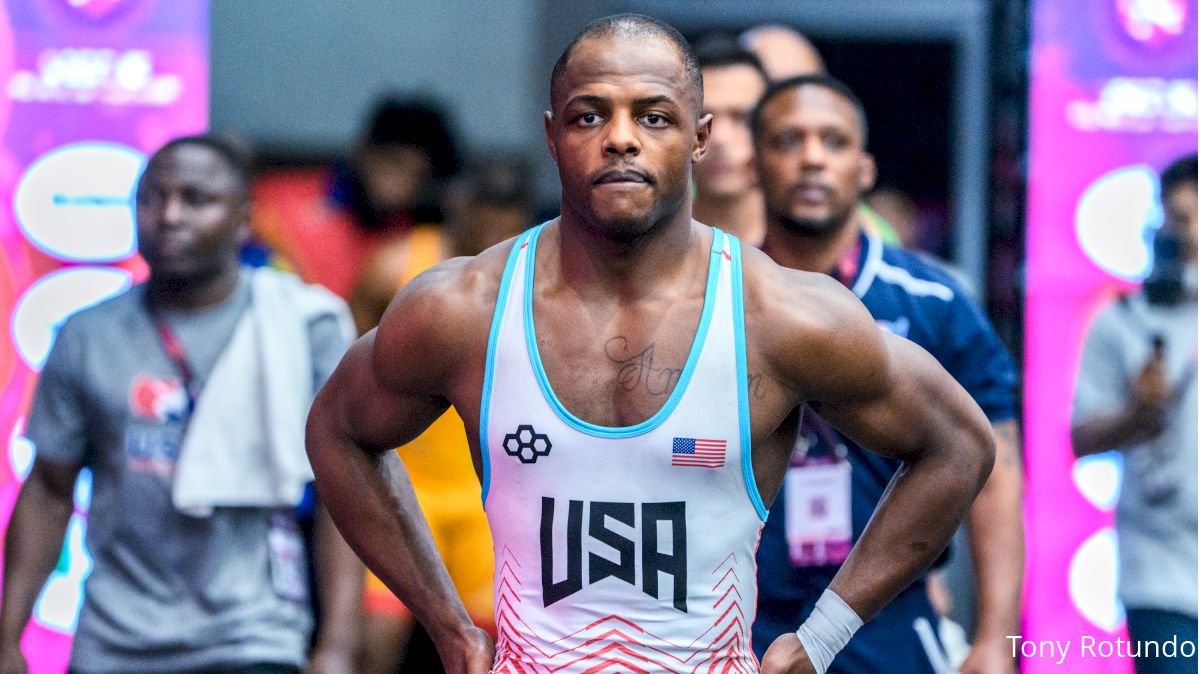
The most difficult objective in wrestling is to earn a medal in Greco-Roman at the World Championships. Most of the planet understands this. The vast majority of wrestling fans in America do not. They perceive that “wrestling is wrestling” and it is therefore interchangeable, aside from the observance of slight differentiations within the rule sets, which represent various lines of demarcation.
However, if this were true — that wrestling is essentially all the same — then there would likely be little to no resistance when it comes to recruiting high-profile collegians or freestyle stars for the United States Greco program. Back a generation ago, indeed, there were instances of crossover involving terrific folkstyle/freestyle athletes forging Greco-Roman careers, some of whom went on to experience great success. That is no longer the case due in large part to how much more specialized and competitive the style has become throughout the globe.
Few sane American wrestlers beholden to even a modicum of above-average ability in folkstyle dare consider coming over to Greco, and the ones who do are, most of the time, athletes who have appeared in U17 or U20 World tournaments and for whom Greco-Roman is already their preferred discipline. Both collectives in this current era know what it is they are up against, which is a sport that is passionately practiced and developed in other nations from an early age, thus generating a chasm in skill sets that is incredibly challenging to overcome. The difference is that the first bunch of youngsters tend to shirk from such an endeavor, and perhaps rightfully so, while the latter batch of wrestlers is comprised of determined lunatics who embrace such an assignment.
The second group describes a substantial portion of the USA roster for the Greco-Roman World Championships this week in Zagreb, Croatia.
Of the 10 athletes who will represent the U.S. when Greco begins on Thursday, only two attended traditional NCAA collegiate wrestling schools — Michial Foy (97 kg, Army/WCAP) and Cohlton Schultz (130 kg, Atreus WC). Jayden Raney, U17 World gold in ‘24, has committed (along with his twin brother, similarly-decorated Jordyn Raney) to Oklahoma State, which means that if one desires quibbling over technicalities, they can throw him in that mix, as well. Nevertheless, all three are “Greco guys”, with Raney still too young to have yet begun his collegiate exploits, and with Foy having only recently zeroed in his efforts on the classical style. As for Schultz, everyone knows the deal. While enrolled at Arizona State, he managed to make three Senior World Teams, following an age-group career that included a Cadet World title, a Junior bronze, and a Junior silver.
Except for one World Teamer, the rest of the American lineup are all athletes who, after high school, transitioned immediately to Greco, with the lone exception being U23 World silver Beka Melelashvili (82 kg, NYAC) — and that is only because Melelashvili was born and raised in Georgia, having come to the United States two years ago. In Georgia, Greco-Roman is heavily prioritized over freestyle.
The six other combatants bypassed folkstyle (and freestyle) not just prior to high school graduation, three started full-time Greco even earlier than that: Alston Nutter (67 kg, Army/WCAP), and ‘24 Olympians Kamal Bey (77 kg, Army/WCAP) and Payton Jacobson (87 kg, NYAC/NTS). For the U.S. to have any shot of ever returning to the sort of relevancy in international Greco-Roman that is expected from the American wrestling fanbase, the type of commitment wrestlers like Nutter, Bey, and Jacobson made is as close to being a necessity as it gets.
And even then, success is far, far from guaranteed. Why? Because, again, the Greco-Roman Worlds is the toughest tournament in wrestling by a significant margin — for every country, not just the United States. There are more entrants than in the other two disciplines, returning World medalists regularly come up short the following year, and it is a style that sees the most minute errors change match complexions in verifiable instants. These attributes are why the style is the most popular and participated worldwide, and they are also why it means so much for athletes to earn podium spots. Not one inch can be taken for granted.
From a brief scouting perspective with regards to Team USA at the World Championships, there are certainly those on the roster who should be expected to have an opportunity to advance and potentially contend. There are also those for whom expectations should probably be tempered. Though it might be fun (and this whole thing is supposed to be fun, isn’t it?), projecting possible placewinners or number of medals is practically an absurd exercise. On a near-annual basis I am asked something to the effect of “how many medals do you think we’ll get?” I’m dumb enough to where I used to answer the question, but have since smartened up a little bit. Nowadays my answer is very simple: “either zero or 10.” Things change from round to round, from period to period, from position to position, and not all draws are created equally. Taking a swing at who might medal and for whom such a thing would be a massive surprise does not yield juice that is worth the squeeze. Too tough of a tournament, too chaotic are its machinations.
One item that does render a difference compared to other recent USA Greco-Roman World Team selection processes is the allotment of time that the roster has had as a cohesive unit, which should provide an interesting backdrop when watching the World Championships. In ‘25, the Greco-Roman World Team held its roster selection at the U.S. Open in April. This meant withdrawing from the typical three-tiered system that involves the Open, a World Team Trials Challenge Tournament, and participation in Final X. Since the Team was formulated nearly two months earlier than has been the norm (dating back to ‘19 for World Championship years), they have received additional training opportunities such as a multi-week stay in Azerbaijan and a hefty camp in Colorado Springs (that included Croatia, Georgia, and Ukraine).
This pair of training camps combined with the extra time overall to gel as a Team is something that National Team head coach Herb House has banked on to deliver an impactful change to the dynamics of the squad and assist in their becoming better-prepared to encounter the obstacles present in Zagreb. In addition, the ‘25 World Team arrived in Croatia (Porec) for this tournament more than two weeks ago for acclimation purposes as well as for supplemental time to get “looks” against foreigners.
Although the United States Greco program attempted a similar pre-World Championships protocol in ‘17, the circumstances are not the same. Turnover is one reason (Ellis Coleman is the only ‘25 World Teamer who was also on the ‘17 roster, a fact that speaks to Coleman’s longevity and adaptability), youth is another. Raney is just 18 years old, Black is 22, Jacobson and Melelashvili are both 23, and collectively the average age of the Team is 25.5. Most of the ‘25 World Team, and the National Team as a whole, were mere sprites back in ‘17. They do not see the intricacies and nuances of Greco through the same lens as those who came before them. If anything, the youths in ‘25 are more equipped due to having garnered authentic, relevant experience on a large scale when contrasted against those from the previous era.
Just how much of a difference any of this could, or might, make in ‘25 remains to be seen. But even if it does not, potential detractors would do well to understand that this is all part of a long-term plan for the Greco-Roman program and is not limited to this year’s tournament in a vacuum.
Brief Individual Scouting Reports
The draws are scheduled to be released Wednesday afternoon (Croatia time). In the meantime, here are brief profiles of each member of the Team USA Greco-Roman World Team, along with their perceived strengths and weaknesses.
55 kg: Jayden Raney (NYAC) — First Senior World Team
The Pan-Am Championships in May represented Raney’s lone appearance in a Senior event following the World Trials. Though it would have been nice to see him compete in Europe throughout the course of this training cycle, the understanding is that he has been performing quite impressively in the room, and against some top-flight foreigners. He is such a kinetically-charged and aggressive wrestler with fantastic hips that he may very well find avenues to score in Zagreb. It is hard to picture him defending from bottom successfully against the better guys in this bracket, but if he bucks convention and actively pursues points via “floating” and scrambling, he could piece together a tremendous debut.
60 kg: Max Black (NYAC/NTS) — First Senior World Team
Black is on this Team for two reasons: he has done nothing other than consistently improve, and because he is one of the fiercest competitors of his generation thus far. The work he has put in, the type of investments he has been willing to make, are starting to pay off. He has been compromised physically throughout this year (and this summer, too), but it has not stopped him. Black has done all he can to transform his vulnerabilities into actual weapons, and that includes defending from bottom. The 60 kg class is, as usual, loaded, but Black has gotten more time-on-target this year against high-quality foreigners and how that translates to this week will be critical to bear in mind when he is called on-deck.
63 kg: Ellis Coleman (Army/WCAP) — Fifth Senior World Team (Two Olympic Teams)
Rightfully so, many are pointing towards Coleman as one athlete capable of making a big run this week. There is evidence to back that up. To put it succinctly, when Coleman has looked good this season, he has looked great (particularly overseas). He has also had some matches in which he didn’t look so great. That’s how it goes. 63 kilograms has been an adjustment for Coleman, who prior to this season hadn’t been this light in over a decade. He has put a major emphasis on trying to stay light even between tournaments so as to avoid depleting last-minute cuts. And, of course, with Coleman now in his 30’s (34), he has to take better care of his body, which is worth noting given how many injuries have plagued parts of his stellar career, and from which he has returned. Word is that Coleman is, colloquially, super keyed-in right now and has been on fire the past couple of weeks. The first match of the tournament could be the toughest, regardless of draw; but, if Coleman is warm, confident, hydrated and energized, look for him to go far in this thing thanks to that wondrous elbow-to-elbow gutwrench and uncanny ability to outpummel, and outhustle, everyone he faces.
67 kg: Alston Nutter (Army/WCAP) — First Senior World Team
Nutter, who as mentioned helped pioneer the “go full-time Greco before college” movement, has not received the credit he is deserving for his making this World Team. People apparently forget (and quickly), but Nutter was on the shelf for two years entering the ‘25 Trials, at which he by and large breezed past the field to capture his first spot on a Senior World-level roster. As an athlete, he is considered one of the country’s most well-rounded. Nutter does not go to battle as a former folkstyler who gets caught in-between during positions. Instead, he knows what he wants to do and has the instincts to pummel or chain towards something else on a dime if that is what the situation dictates. 67 kg is a shark tank. Maybe the most packed weight in this event, or at least it’s right there with 77. The best thing Nutter has going for him is that it really comes down to two things: defending, and finding a score of any variety from the feet. If he can come up big should he find himself in bottom par terre, then advancement into the later rounds is not only possible, but plausible.
72 kg: Alex Sancho (Army/WCAP) — Third Senior World Team (‘20 Olympic Team)
Alex Sancho should be seen as one of the best hopes Team USA has for a medal in Zagreb. No question about it. He has performed against the level of opposition present in this bracket, and with success, often enough to be able to make such a bold declaration. That is not to discount prime characters such as two-time Olympic silver Parvis Nasibov (UKR), or top-seed Ulvi Ganizade (AZE), or whomever else one might want to name. There are some seriously dangerous dudes in this weight. But Sancho is one of them. He still wields an electrifying hybrid straddle lift from top that has been responsible for dismantling numerous big-ticket international studs, and it is from top par terre where Sancho might be the best in the country. Focus and motivation are the keys. When Sancho is locked-in hardcore, he is on the same wavelength as any multi-time medalist in the bracket. That, coupled with him having moved up from 67 to 72, provides further value in his Zagreb stock.
77 kg: Kamal Bey (Army/WCAP) — Fourth Senior World Team (‘24 Olympic Team)
Bey can wake up on the right side of the bed, shake off residual grogginess, make weight, and go on a tear that leads to the finals and culminates with a gold medal the next day. So prodigious is his talent, so immense his scope of capabilities. Kamal does not require many more sentences to describe. It is all pleasantly uncomplicated. There is no one at 77 kilograms he cannot beat. If anything, he has already snagged wins against most of them, and not one of them wants to be paired with him in this tournament. The only time foreigners are copacetic with wrestling Bey is at camps, that way they can feel and study him more without consequence. Other than that, they don’t want to have to deal with what he has to offer. Who can blame them? None of this is to suggest it is easy work for him. It’s not. It is actually the hardest work available. But if Bey is up to it, and if he dares open up aggressively throughout the entirety of his matches, he is a medal waiting to happen. As he always is.
82 kg: Beka Melelashvili (NYAC) — First Senior World Team
Consensus is that returning U23 World silver Melelashvili is one more medal candidate for the American Team. This does not necessitate a grand amount of unpacking. Beka “does” Greco-Roman wrestling the way the foreigners do, because he grew up as one of them and so he wrestles like one of them. Not hard to follow. We’re talking about solid positioning and making worthwhile attempts, and not settling for sub-standard locks from top par terre before trying to gut. In fact, that is one piece to this puzzle. Beka’s movement from his lock has resulted in others becoming injured either directly from the technique or as the byproduct of his follow-up. It is a fearsome position for opponents. Melelashvili on defense is suitably stout. Not precisely impenetrable, because no one is. But par terre bottom is not the same weakness for him that it is for others on this roster. A fantastic wrestler who is still so young, and also so grateful to be in this spot.
87 kg: Payton Jacobson (NYAC/NTS) — First Senior World Team (‘24 Olympic Team)
No one works harder, and no one holds themselves to a higher standard than one Mr. Jacobson, who made this World Team following another thrilling series against Spencer Woods back in April. He is hard on himself. Very much so. Jacobson trains to a level which indicates, to him, that he should defeat anyone and everyone with whom he shares mat space – this despite having only recently turned 23 and is still in the early stages of his career. It is the type of mentality you wish the entire program had. As for his viability in Zagreb, Jacobson is a wildcard, but there is a formula. For starters, he has to own his stature. Jacobson is short for 87, so navigating ties and pummeling for position has to be on his terms. In other words, he has to lower his opposition to him instead of getting caught up in lengthening his body – all without backing his hips away, lest he risk passives. Attempts from his drags and just creating bruising motion in general are also a good idea. Jacobson can indeed score from the feet. He has improved from bottom, but a sound pathway for him would be to continue battering foes while standing enough to where opponents are wavering by the time they have a chance from top par terre. All of the decorated guys here know what is in store for them. Jacobson brings an energy that is tough for them to absorb. He can frustrate them, now he needs to score on them.
97 kg: Michial Foy (Army/WCAP) — First Senior World Team
It has been a lot for Foy, who really shined at the Trials and caught some, but not all, by surprise. More importantly, he recently became a first-time dad. It is a lot of blessings in a short period of time. In an athletic context, there is so much to like about Foy’s progress and sharp, fluid approach but he does have a couple of deficits. One is that he is a bit undersized for 97. If this weight were 92 or 94, different story. Another is that, although Foy did make a U23 squad a couple of years ago, he does not have a ton of experience in this style internationally. Now that is not necessarily an enormous hindrance for him on-the-feet. Foy’s short drags off of nifty pressure-releases can reset anyone’s footing. Par terre bottom, that is where being new to this level is an issue, and it is one of which overseas guys enjoy taking full advantage. Foy is learning as he is going. A sincerely impressive prospect who will learn from this tournament, but the US is hoping that he can collect some wins along the way.
130 kg: Cohlton Schultz (Atreus WC) — Fourth Senior World Team
Many within the Greco community have been waiting to see what Schultz might be able to do, and how he might fare, once his collegiate days were behind him. This is less about the tribalistic divide between the wrestling styles and more about Schultz having the room to just focus on one of them in totality. He has participated in every phase of this World Team training cycle, he has competed and put forth solid efforts, and is clearly starting to approach the peak of his powers. Watching him work is a pleasure. He automatically finds the tiniest wrinkles to exploit, be it a small tweak in hand placement or where he is putting his feet. These are not small things. No, they are big deals in a weight category featuring big men. Schultz has also fallen in love with front headlocking people from top par terre. He gets away with this domestically. Internationally, not as much. He can change course and go conventional gut, but his is not as reliable as it needs to be to overtake the front headlock. Thus, a gutwrench is his secondary option. However, neither of these techniques are mandatory for his candidacy if only because if and when Schultz scores in Zagreb, it is easier to picture points coming his way as the result of step-outs and takedowns as opposed to his par terre work. Other than that, the narrative does not change for him. It is similar to the others – score and defend from bottom. Two wins on the championship side of this bracket for Schultz could mean the breakthrough for which he has been searching.