The high school wrestling scene in California has become increasingly top-heavy with five programs dominating the landscape.
Those five teams finished well ahead of the rest of the field at last weekend’s single-class CIF Boys Wrestling Championships.
Buchanan, ranked #5 in the Flo 40, finished in first with 247.5 points, while #10 Poway finished second with 240. Just behind Poway was #12 Gilroy with 239 points. Finishing fourth was #11 St. John Bosco with 229.5 points, and #20 Clovis took fifth by scoring 211. Clovis beat sixth-place finisher Clovis North by more than 65 points.
Throughout the tournament, it was unclear who was going to walk away with the team title. Poway was the leader after Day 2, but Buchanan took the lead on the final day with all eight of its placers finishing fourth or better, earning some valuable placement points.
“Obviously, I was proud that we did enough to win,” Buchanan coach Troy Tirapelle said Tuesday in a phone interview. “When it got to the nitty gritty, we had enough kids kind-of get tough. As a whole, it wasn’t our best performance. We expected more and I thought we should have won pretty handily with what we had. You need all your top guys to pull through and make sure they score every point possible to be successful, and they did, so we ended up coming out on top.”
The Bears had five finalists, led by 120-pound champion Rocklin Zinkin, who recorded three technical falls and two wins by fall before he beat second-seeded Edwin Sierra of Poway 7-2 in the finals. According to Tirapelle, the Oklahoma State commit Zinkin has been widening the gap between himself and his competition.
“If you want to wrestle DI, then you got to start distancing yourself from the other guys, and he definitely did that this year,” Tirapelle said. “He took that to heart, and I hope he continues that path because that was a pretty dominant performance throughout the year.”
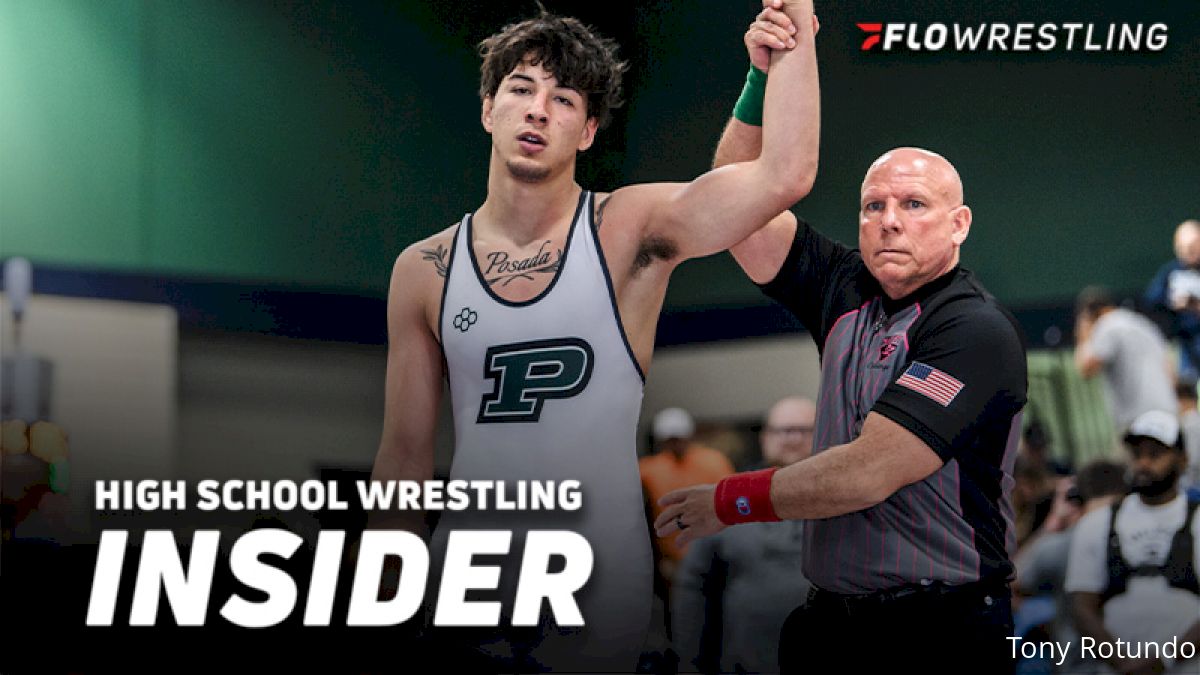
Runner-up Poway was led by a pair of champions in #3 Angelo Posada at 215 pounds and #12 Mario Carini at 165. Both pinners, Carini had four sticks at the state tournament while Posada had three.
“Mario looks for those pins, but a little bit different – Posada is a big suck-back, half guy, and Mario is a bar guy,” said Poway coach John Meyers. “We’re always looking for pins – we talk about it every day of the state tournament.”
Carini went through a tough bracket. He pinned #19 Travis Grace of Gilroy in the semis in the third period while trailing 4-3 before taking out Super 32 champion #8 Joseph Antonio of St. John Bosco in the final 5-4. Posada wasn’t really challenged in his bracket until a 10-4 win over fourth-seeded Wes Burford of Oakdale in the semis. He shut out #9 Khale McDonnell 7-0 in the final.
“Angelo Posada, he’s our leader. We have a pin award and this will be the third year in a row that he wins it for Poway. He’s got 34 or 35 pins this year, and he only has 41 matches on the season,” said Meyers. “Really big match for (Carini in the semifinal), and that kind of catapulted him into the finals – he went in there with some serious confidence.”
Also recording four pins for Poway was heavyweight Nick Moylan – he finished third after a 10-2 win by major decision in the third-place match. According to Meyers, Moylan’s late cut and takedown for the bonus point proved to be the difference in a tight team race for second.
“We cut the kid with 16 seconds left and took him down, so we got an extra bonus point, and that’s sort of what catapulted us over Gilroy, I think. Kudos to (Moylan) because he listened. When the coaches got the message from me, they told him, and he didn’t even blink. He cut him and went out and double-legged the kid and took him down,” Meyers said. “I slept with a smile on my face Saturday night — I was happy with the way that we wrestled and I thought we wrestled over our potential.”
As for Gilroy High School, head coach Daniel Cormier has his top-end talent humming. The Mustangs had five wrestlers in the finals and won all five matches — an incredible feat, especially in a state like California with just one class.
“Gilroy is so impressive — I don’t know if anyone’s ever gone 5-for-5 in the finals,” Tirapelle said. “They were favored pretty heavily in some of them, but that’s a testament to them.”
At 126 pounds, #11 Isaiah Cortez registered two pins, a tech and two major decisions on the way to his state title, while brother #13 Elijah Cortez won a state title at 138 pounds. Both are committed to Cornell. At 132, Michigan commit #5 Moses Mendoza was dominant, racking up four pins and a tech on the way to the top of the podium. At 150, #1 Daniel Zepeda won his third state title to end his storied high school career before heading to NC State. Recently becoming eligible after transferring from Colorado, Nebraska commit and #4 Tyler Eise won his first California title after winning two in Colorado.
Beyond that, Gilroy also saw #19 Travis Grace finish third at 165, and Kaleo Garcia took seventh at 190.
“I never expected coming into this year that we would be close to those top three teams — I just thought (the other top teams) had kind of too many ones — you could see it in Gilroy with five guys winning the state tournament. If you have some kind of supporting cast there, you’re probably going to win it,” Meyers said. “I think things worked out really well for us and Buchanan to pull out in front because Gilroy’s supporting cast had two other placers. Then Bosco — what I didn’t expect — they didn’t have any champions. Those big points are in the consi-semis, those five-point wins there.”
As for St. John Bosco, they set a California state record with 13 total placers out of its 14 wrestlers — the only non-placer was a backup who was filling in for the #2 heavyweight Nicholas Sahakian who wasn’t available.
“We had some adversity we had to overcome with Niko Sahakian not being able to wrestle and compete in this tournament,” St. John Bosco coach Jenaro Santillan said on Tuesday. “I do believe that had we had him, it would have given us the points we needed to win it.”
Despite not having an individual champion, St. John Bosco finished with two runners-up, two thirds, a fourth, a fifth, four sixths, two sevenths and an eight-place finisher.
Lastly in this group of five teams — all ranked in the Top-20 nationally — is Clovis. The Cougars had nine wrestlers land on the podium, led at 144 pounds by #2 Nikade Zinkin, who knocked off #4 Joseph Toscano of Buchanan for the sixth time this season in the final to capture his second state title.
“I thought we wrestled very well. Of the top five teams, we might have wrestled the best. We just didn’t have the horses that some of the other teams had, and that’s OK,” said Clovis assistant coach Adam Tirapelle. “That’s just a part of wrestling — you are just trying to do the best you can possibly do, and I think most of our guys did about the best they could do. Even in our losses, we looked good. Sometimes you get beat and you wrestle well, and sometimes you win and you don’t wrestle well. It was a good tournament for us.”
So, How did California Get To This Point?
It sure seems that the top-tier talent in California has gravitated to these five programs, but why? And is it good for the overall wrestling product in the Golden State?
Talking to the coaches at these schools, it seems the answers to these questions vary, but there are some key factors that they all acknowledged — the shortage of college wrestling in the state, the leniency of its transfer rules, and the scarcity of top-tier coaches.
According to Troy Tirapelle, the consolidation of talent isn’t necessarily a good thing for the overall wrestling product in the state.
“You got most of the better kids trying to run to specific programs, and there’s a reason they do it — I’m not saying anyone is cheating, I don’t mean it like that. But you’ve got five teams that worked really hard and are really good, then there’s a major drop-off,” he said. “Kind of gone are the days of ‘I went here, my son’s gonna go here.’ I don’t know if that’s really good or bad — I like more when the kids kind of stay where they’re at, but you can’t stop them from moving.”
On the contrary, Santillan thinks that the best talent going to a handful of schools only makes them better because the competition is more fierce at the top.
“I think we all make each other better — we all try and set the bar a little higher every year,” he said. “We’re all looking for that top spot.”
As for Poway’s Meyer, he pointed toward the lack of high-level wrestling in the state as compared to out East.
“I’ve always thought of California as a great high school wrestling state – I think it hurts us a little bit with the lack of high-level college wrestling. Here in San Diego, our kids don’t get to watch real high-level wrestling unless they go up to Cal Baptist, which is an up-and-coming program,” Meyer said. “We made a real concerted effort to introduce our kids to the highest level of wrestling. When I became head coach, we made it a priority that the state tournament is not the toughest tournament we go to. These kids are ready to try to make World Teams and win Fargo titles. We make a big effort to push that and get those really tough matches and get in front of high-level coaches. We’re making a serious effort to educate the kids and the parents on college wrestling and get them in front of the best wrestling that we can in the offseason.”
According to Adam Tirapelle, the lack of consistency in the state’s rules is a major factor, likening the process to how the US Government works with its states having their own power with the federal government overseeing things. California is split up into sections that each have their own different rules for things such as transfers, dead periods and summer workouts.
“There are different rules for different sports in different sections – we still have soccer that plays in the winter in some sections and in the fall and spring in other sections,” Adam Tirapelle said. “There’s no consistency, so it’s really hard to get everybody on board with change.”
How Can The System Be Improved?
As for this question, there’s a lot of disagreement about how to sort of spread the wealth in California. Some say they need to split things up in divisions. In a state with a population near 40 million people, many want to see multiple divisions like other states have, but there are also others who do not want to see it change from a single-class state tournament. In fact, California has multiple divisions in other sports, such as football where 15 teams are crowned state champs each year.
“I know a lot of people want us to split the state up, but I don’t think that’s a good idea — I don’t think that’s fair to the programs like us who put in so much time year-round, and we strive and work hard to get to this point,” Santillan said. “Being that we have a true state champ, it’s a very difficult task to achieve, and it just keeps California wrestling amazing.”
Clovis’ Adam Tirapelle disagrees, arguing that having only one class actually dissuades some schools from focusing on the sport and keeps some kids from wrestling at all.
“I always personally think that divisions would help — I think it would give other people a reason to try because right now, it doesn’t matter how much you try,” he said. “When they think of divisions — especially in California — (the critics) think that it’s going to divide all the top schools. It’s not going to divide all the top schools. We’re all still going to be in Division I. Do I think it solves the problem? No, I don’t. It’s not like if we went to divisions, all of a sudden California has all these coaches and all these great wrestlers and all these great programs, but I think it would at least give people a reason to show up and put effort in.
“If you show up at a race, and you know for sure the best you can do is last no matter how hard you try, how much effort are you giving? That’s kind of where the rest of our teams are at. No matter how hard they try, they’re not even close. You look at the numbers of finalists and champions and medals, it’s such a gap now I don’t know how you switch that around.”
One place you start would be to somehow attract more college-wrestlers-turned-coaches, according to Adam Tirapelle.
“We’ve lost a lot of college programs in California over the last 40 years, so there’s nobody coming out of college to coach these kids. Look at Pennsylvania and how many of those coaches wrestled in college — almost every coach in Pennsylvania wrestled in college,” he said. “We have hardly any, especially with the size of our state. We’re the biggest state in the Union, and we hardly have any coaches. It’s hard to say that the other programs are just not getting coaches, there’s not that many coaches to get.
“There’s no easy solution because we don’t have a lot of college programs, we don’t have a lot of people who have gone through and are able to coach at a higher level. Then, we have very liberal transfer rules, which makes it easier for people to just move around. It’s really not a fair system.”
With no real fix in sight, Adam Tirapelle expects more of the same going forward with the top teams in the state continuing to widen the gap between themselves and the rest of the field.
“That’s why we have elite teams. We have five Top-25 teams in the country because we’re getting a bunch of kids that are really into wrestling that want to come here so they can get better at wrestling — and we do make them better,” he said. “But at the same time, it makes the other programs worse, but the other programs don’t have the resources or the coaching to help the kids reach their full potential. It's the chicken or the egg, right? You see both sides, but it’s why we have what we have.”